

Authorized Training Center (ATC) Verification
Enter the full official Training Center name exactly as authorized by ABI Certifications™ and select the country of authorization.
Verification results are provided for confirmation purposes only and reflect the status of records maintained by ABI Certifications™ at the time of inquiry.
Authorized by ABI Certifications™
ABI Certifications™ operates a structured Accredited Training Center (ATC) framework to support the global delivery of certification-related training while maintaining centralized certification governance, impartiality, and credential integrity.
The ATC framework enables qualified organizations worldwide to deliver ABI Certifications™-approved training programs under defined accreditation requirements, while all certification decisions and certificate issuance remain exclusively with ABI Certifications™.
Purpose of ATC Accreditation
The purpose of ATC accreditation is to ensure that training delivered in support of ABI Certifications™ certification schemes is consistent, controlled, and aligned with approved certification requirements.
ATC accreditation exists to support certification integrity by ensuring that training delivery meets defined quality, governance, and compliance expectations.
ATC accreditation is not a license to issue certificates.
Certification Authority and Decision Control
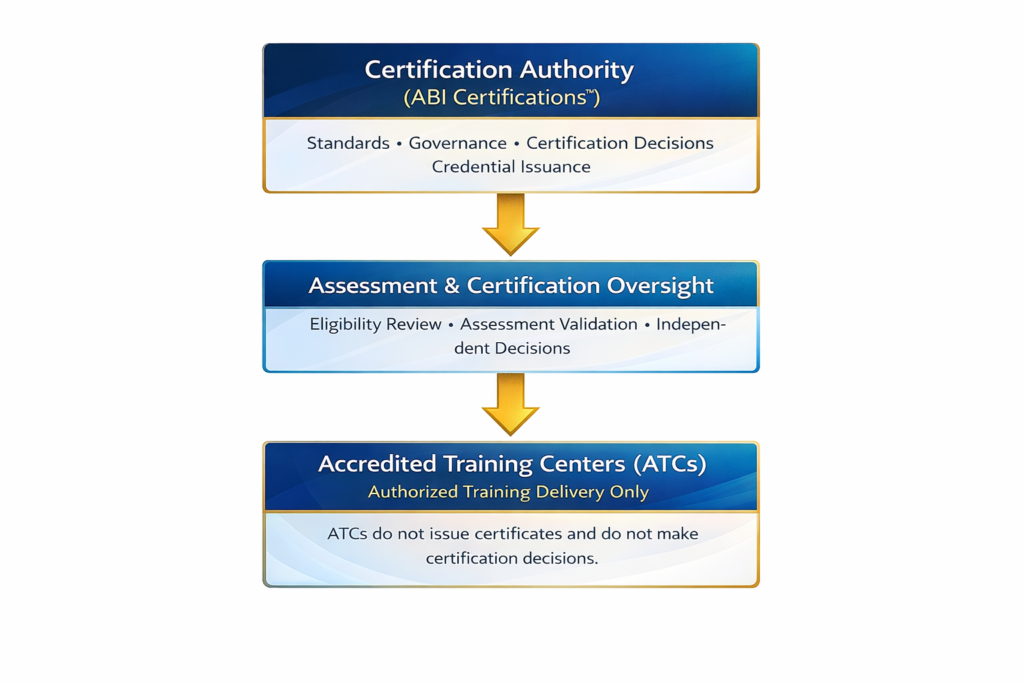
All certification reviews, assessment validation, certification decisions, and certificate issuance are performed solely by ABI Certifications™ following successful assessment and evaluation in accordance with defined certification requirements.
This governance structure ensures impartiality, consistency, and integrity across all ABI Certifications™ certification outcomes.
Role Separation: Certification Authority and Training Delivery
ABI Certifications™ operates as the certification authority.
Accredited Training Centers operate as authorized training delivery organizations.
This formal separation ensures:
• Impartial certification decisions
• Consistent certification outcomes
• Protection of credential credibility
• Confidence for employers, professionals, and stakeholders
Responsibilities of ABI Certifications™
ABI Certifications™ retains full authority over:
• Certification scheme development and governance
• Eligibility and competence requirements
• Assessment and examination rules
• Certification decision-making
• Certificate issuance, suspension, and withdrawal
• Maintenance of certification records and online verification
Responsibilities of Accredited Training Centers (ATCs)
Accredited Training Centers are authorized to:
• Deliver ABI Certifications™-approved training programs
• Provide learning support aligned with approved syllabi
• Manage learner registration and attendance
• Maintain training delivery and attendance records
• Comply with defined monitoring and reporting requirements
Scope of ATC Accreditation
ATC accreditation is granted for a defined scope only.
Accreditation may be limited by:
• Specific certification programs
• Approved instructors
• Delivery modes (classroom, virtual, or blended)
• Approved training locations
ATC accreditation does not authorize:
• Certification decision-making
• Certificate issuance
• Independent representation as a certification body
All certifications are issued exclusively by ABI Certifications™.
Eligibility Requirements for ATCs
Organizations applying for ATC accreditation are expected to demonstrate capability, professionalism, and compliance with defined accreditation criteria.
Eligibility considerations may include:
• Legal registration and organizational legitimacy
• Experience in professional or technical training delivery
• Adequate training infrastructure and learning resources
• Availability of qualified instructors
• Administrative systems for learner and record management
• Commitment to compliance with accreditation conditions
Each application is evaluated independently in accordance with defined accreditation requirements.
Instructor Qualification Requirements
Instructors delivering training under the ATC framework must be competent within the approved program scope.
Instructor requirements may include:
• Relevant academic or professional qualifications
• Demonstrated industry or professional experience
• Alignment with certification program objectives
• Familiarity with approved training materials and learning outcomes
Instructor approval may be program-specific and subject to review
ATC Accreditation Process
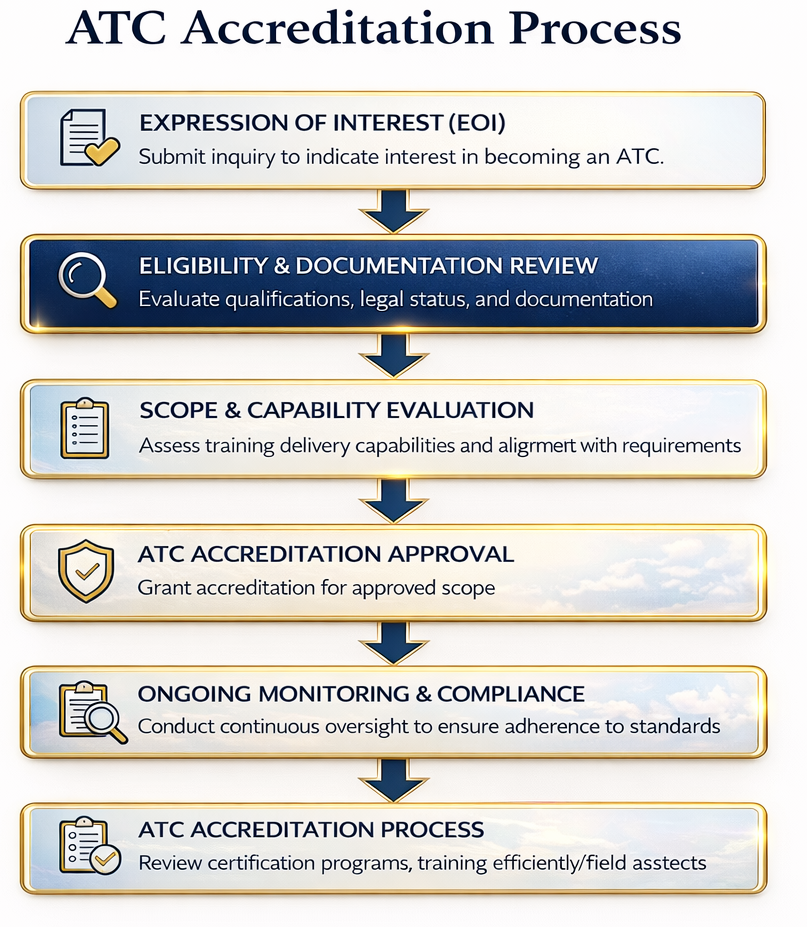
The ATC accreditation process is designed to ensure fairness, transparency, and consistency.
The process may include:
• Submission of an official ATC application or Expression of Interest
• Review of organizational and legal documentation
• Evaluation of training infrastructure and delivery capability
• Review of instructor qualifications
• Accreditation decision and defined scope approval
Accreditation is granted for a defined scope and may be subject to periodic review
Monitoring, Compliance, and Oversight
ATC accreditation is subject to ongoing monitoring to ensure continued compliance with accreditation requirements.
Monitoring activities may include:
• Review of training delivery records
• Verification of instructor alignment
• Evaluation of learner administration practices
• Review of compliance with approved syllabi
• Investigation of complaints or concerns
Failure to comply with accreditation requirements may result in corrective actions, suspension, or withdrawal of accreditation.
Use of ABI Certifications™ Name and Accreditation Status
Accredited Training Centers may reference their accreditation status only in accordance with defined usage and branding rules.
ATCs may:
• State their status as an ABI Certifications™ Accredited Training Center
• Promote approved training programs within the authorized scope
ATCs may not:
• Represent themselves as a certification body
• Issue certificates on behalf of ABI Certifications™
• Modify certification requirements or certification outcomes
Benefits of ATC Accreditation
ATC accreditation provides organizations with:
• Authorization to deliver ABI Certifications™-approved training
• Alignment with structured certification frameworks
• Participation in a governed global certification ecosystem
• Enhanced credibility with learners and employers
• Recognition within an internationally oriented certification system
Global ATC Network
ABI Certifications™ supports the development of a global network of Accredited Training Centers to enable consistent training delivery across regions while maintaining centralized certification governance.
The ATC framework is designed to support:
• International reach
• Local delivery capability
• Centralized certification control
• Global recognition of credentials

Applying for ATC Accreditation
Organizations interested in becoming an Accredited Training Center may submit an official inquiry or Expression of Interest to ABI Certifications™ for information regarding eligibility requirements, accreditation scope, and application procedures.
Submission of an inquiry or Expression of Interest does not constitute approval or accreditation.